I figured things have been rather quiet lately here so I decided to talk about a few books I have been going through recently and books I've finished recently.
Excelling at Chess Calculation by Aagaard
I really like this book, there are some very interesting problems and it really does give ideas on how to improve your calculation and things to be weary of while calculating. I've actually read through it once before, but reading it now it's obvious my first reading wasn't too attentive. I'm not sure how much of this book is easy to pick up, most of it needs to be done through practice which it doesn't necessarily provide on it's own, but it does give suggestions for organization of thought.
Chess Self-Improvement by Zenon Franco
This book has a pretty cool cover and the first time I heard of it I thought it was pretty dorky and that the book wouldn't be of much interest to me. Actually this is an interesting book and if you spend the time to really go through the games with serious concentration you can gain a lot. I feel like if you spend the effort this is as closed to a simulated game environment you can probably get. The moves he asks you to try to figure out vary in difficulty and the points are awarded in various fashions. I will note, don't even both with this book if you plan on just skimming through it, that's a waste of your time.
School of Chess Excellence 1: Endgame Analysis by Dvoretsky
I bought this book really recently and have just started working through it, but it seems very good so far and is much more theoretically based than the bulk of Dvoretsky's other work Dvoretsky's Endgame Manual. Here a lot of time is spent talking about playable positions and I feel like I will be able to learn a lot from this book. He goes over some very tough endgame positions from real games, often times where players had hours to analyze in adjournment.
Chess for Zebras by Rowson
A good deal of the book so far is spent presenting information from Seven Deadly Chess Sins in a different manner, but a lot of it is spent on chess improvement. I don't know how particularly relevant it is to me now in this manner, but after reading a review of this book and browsing through it I decided it was certainly worthwhile. His writing style is very candid and always enjoyable. It's certainly one of those books I could work through, not absorb anything and still enjoy it.
Wednesday, April 26, 2006


Wednesday, April 19, 2006
On the shoulders of giants...
One of my favorite quotes:
“If I have seen farther than others, it is because I was standing on the shoulders of giants.” - Sir Isaac Newton
To me I always find it strange when people refuse to study openings because they claim it's just wrote memorization. And to be fair, there is some memorization involved, but I think far less if you do it right. Let's make a quick mention of a very popular opening, the Najdorf. After 1. e4 c5 2. Nf3 d6 3. d4 cd 4. Nd4 Nf6 5. Nc3 black plays 5.. a6!? This is one of a few moves available to black in the position, but why when black has only one piece developed is he playing this move a6? It somewhat violates many opening principles. It doesn't develop a piece or really even prepare to develop a piece. Nb5 isn't exactly threatened in the position although if black intends to follow up with e5 in some variations this square is protected. However, if we look in many Sicilian lines, Nb5 or Bb5 even when they're sacrifices are important ideas, but certainly time can be taken out to play this a6 later if it can be done now, right??? Well, black is making a useful move that he will almost certainly have to play later in order to see what white does next and also prepares some moves that he will not necessarily play. For example, black would love to play 5.. e5 without including a6 if it weren't for the problem of Bb5+ now white can go to f5 either after 6.. Bd7 7. Bd7+ 8. Nf5 or just 6.. Nbd7 7. Nf5. I'm sure 90% of the players who play the Najdorf below probably 1800 don't even know why a6 is the move there when there is a simple reason that is much easier to remember than the move itself. I think for the most part if you really understand and opening when you encounter a new theoretical move you will understand the logic of it. If you find yourself uncomfortable when your opponents play strange moves in your pet lines, it's probably time you took your pet opening out for a walk in the park to see what's really going on.Monday, April 17, 2006
Western Pacific Open Results! (Updated)
I had a solid performance this tournament. Not necessarily a performance I dream of, but it was close.
In round 1 I played the top seed from the 3-day schedule as I predicted, IM Timothy Taylor. I actually got a strategically complicated position against him and was doing find pretty much the whole game, I was even slightly better for a while, but eventually I just miscalculated and collapsed.
In round 2 I play an unrated who gave me a scare when I overlooked a trick he had, but then I realized that this was not a trick at all as it dropped his queen, I wasn't feeling in the best form for this game, but I won fairly quickly and even mated in the endgame with most of the pieces on the board.
In round 3 I played NM Ilya Serpik who I have faced now for the 3rd time going into this game my record against him was 1-0-1 and we have even played some blitz in between rounds so I was feeling good. He played some offbeat line and I got a very nice position out of the opening with black. I actually threw away most of the edge I got by not spending enough time on some of my moves, but I still got a position with good pressure. He blundered shortly after and I converted no problem.
In round 4 I played NM Gregg Small with white. We reached a very complicated position in the middle game which I decided to show:
White to move
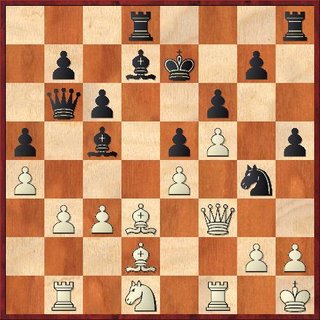 So, I might not have chosen the best continuation here, but I think I found a strong idea. Here I played Nb2!? (The whole point of the maneuver I had made from c3 to d1 was to go to c4). I was showing this game to some friends and they have the nerve to criticize this move which I believe I have full compensation if he takes the exchange which he didn't. I probably could've played Be1 first preparing the same idea, but this was still fine. The line I calculated was 19..Nf2+ 20. Rf2 Bf2 21. Nc4 Qa7 (forced) 22. Rf1 Bc5 here I stopped feeling that if nothing else I would have Qg3 Rdg8 Qh4 with some serious compensation, but in fact, I have a knockout that I couldn't calculate all the way in advance, but looked dangerous. 23. Ne5! fe 24. f6 Kd6 (forced or it's basically mate) 25. fg Rhg8 (or Rhe8 Bg5 with a strong attack) 26. Bc4! and the pawn is immune due to Qf6+ 26.. Kc7 27. Bg8 Rg8 28. Qh5 and white has 3 pawns for the sacrificed piece and a continue attack +/-.
Unfortunately for me, things did not end so brilliantly in the game. My opponent wisely declined the exchange and instead played Be8 after which he eventually broke though at the wrong moment which lost a pawn in a position where I was up a pawn and had a better position. Unfortunately in some mutual time trouble (although his was worse) I fell for his last trick in the position which gave him a slightly better endgame which he ground down very well.
In round 5 I got what I deserved for failing to convert my won position in round 4, I was paired against a 1475 player. I won quickly, but I gained (almost) nothing from the game. It did however bring me up to 3/5 which through some miraculous series of events allowed me to qualify for the state championship candidate tournament in June. I'm looking forward to that and I'm hoping to be able to qualify for the state championship there.
Estimated rating change 2129->2135, not bad, I'll be hoping to be doing some more damage in upcoming events. (Note, had I won my 4th game, it would've been another 12 points gained regardless of my result last round against the IM I would've been paired against)
Rating Change Actually: 2129-2137 due to unrated finishing 1900 instead of expected 1800
In round 1 I played the top seed from the 3-day schedule as I predicted, IM Timothy Taylor. I actually got a strategically complicated position against him and was doing find pretty much the whole game, I was even slightly better for a while, but eventually I just miscalculated and collapsed.
In round 2 I play an unrated who gave me a scare when I overlooked a trick he had, but then I realized that this was not a trick at all as it dropped his queen, I wasn't feeling in the best form for this game, but I won fairly quickly and even mated in the endgame with most of the pieces on the board.
In round 3 I played NM Ilya Serpik who I have faced now for the 3rd time going into this game my record against him was 1-0-1 and we have even played some blitz in between rounds so I was feeling good. He played some offbeat line and I got a very nice position out of the opening with black. I actually threw away most of the edge I got by not spending enough time on some of my moves, but I still got a position with good pressure. He blundered shortly after and I converted no problem.
In round 4 I played NM Gregg Small with white. We reached a very complicated position in the middle game which I decided to show:
White to move
 So, I might not have chosen the best continuation here, but I think I found a strong idea. Here I played Nb2!? (The whole point of the maneuver I had made from c3 to d1 was to go to c4). I was showing this game to some friends and they have the nerve to criticize this move which I believe I have full compensation if he takes the exchange which he didn't. I probably could've played Be1 first preparing the same idea, but this was still fine. The line I calculated was 19..Nf2+ 20. Rf2 Bf2 21. Nc4 Qa7 (forced) 22. Rf1 Bc5 here I stopped feeling that if nothing else I would have Qg3 Rdg8 Qh4 with some serious compensation, but in fact, I have a knockout that I couldn't calculate all the way in advance, but looked dangerous. 23. Ne5! fe 24. f6 Kd6 (forced or it's basically mate) 25. fg Rhg8 (or Rhe8 Bg5 with a strong attack) 26. Bc4! and the pawn is immune due to Qf6+ 26.. Kc7 27. Bg8 Rg8 28. Qh5 and white has 3 pawns for the sacrificed piece and a continue attack +/-.
Unfortunately for me, things did not end so brilliantly in the game. My opponent wisely declined the exchange and instead played Be8 after which he eventually broke though at the wrong moment which lost a pawn in a position where I was up a pawn and had a better position. Unfortunately in some mutual time trouble (although his was worse) I fell for his last trick in the position which gave him a slightly better endgame which he ground down very well.
In round 5 I got what I deserved for failing to convert my won position in round 4, I was paired against a 1475 player. I won quickly, but I gained (almost) nothing from the game. It did however bring me up to 3/5 which through some miraculous series of events allowed me to qualify for the state championship candidate tournament in June. I'm looking forward to that and I'm hoping to be able to qualify for the state championship there.
Estimated rating change 2129->2135, not bad, I'll be hoping to be doing some more damage in upcoming events. (Note, had I won my 4th game, it would've been another 12 points gained regardless of my result last round against the IM I would've been paired against)
Rating Change Actually: 2129-2137 due to unrated finishing 1900 instead of expected 1800
Friday, April 14, 2006
Weekend Tournament: Western Pacific Open
I'll be driving down towards LAX later today to play in round 1 of the Western Pacific Open. If the pre-entries are reliable (I have multiple reasons to believe they are not) then I'll be playing IM Timothy Taylor in the 1st round. I've lost to him twice including one major blunder in the opening which caused me to resign on move 8. Since I've never scalped an IM, I would love to make this my first. I'm feeling pretty well prepared for this tournament as a whole. I had one disappointing game recently, but I believe as a whole I played well that game and I've been doing a lot of tactical exercizes since then to try to build my awareness. Anyways, if I have some nice results I'll be sure to keep you posted.
Monday, April 10, 2006
Gambits Part 5: Another Marshall Gambit
This is definitely the most famous of Frank Marshall's gambits and probably currently the most theoretically important. I have found only one game between masters so far in 2006 where white dared to allow the Marshall, but at top levels anti-marshall systems haven't been yielding much of an advantage if any for white, they're just less worked out. Here is the critical diagram after black's 9.. d5
 I've included pleanty of my personal views and explanations here.
 I've included pleanty of my personal views and explanations here.
Thursday, April 06, 2006
Gambits Part 4: Marshall Gambit in the semi-slav
When you hear the words "Marshall Gambit" you're probably thinking of a position that arises from the Ruy Lopez, but the truth is that Frank Marshall was responsible for a handful of gambit openings that are still employed at the highest level of chess today with incredible soundness and strength. Here I have started within his gambits with the Marshall gambit against the semi-slav
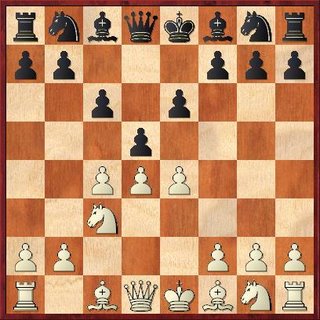 I have provided some analysis mostly covering a recent game Aronian-Vallejo Pons but also talking a little bit about some ideas. Not the normal ideas I usually like to provide, but this line is very theoretical and I'm not trying to turn this into a theoretical survey. Check here for my analysis.
 I have provided some analysis mostly covering a recent game Aronian-Vallejo Pons but also talking a little bit about some ideas. Not the normal ideas I usually like to provide, but this line is very theoretical and I'm not trying to turn this into a theoretical survey. Check here for my analysis.
Monday, April 03, 2006
Gambits: Part 3 - The Reversed Halloween Gambit
Some of you are probably asking how much time I plan on wasting with piece sacrificed right from the opening. Well, I think this time you might be surprised by how sound this opening is.
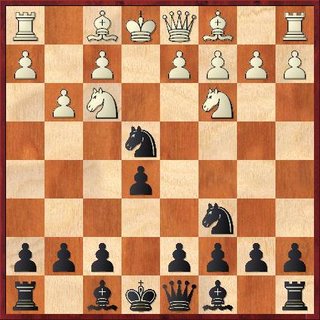 I think this is a good lesson on tempi. Sometimes it's important that the move you make is a good move. For example, some players play the exchange french hoping to make use of their extra tempo. Making use of an extra tempo can be difficult without giving your opponent an opportunity to take advantage of your move. If you don't know what I'm talking about then you can compare the analysis to the reverse gambit to the analysis of the Halloween Gambit itself.
 I think this is a good lesson on tempi. Sometimes it's important that the move you make is a good move. For example, some players play the exchange french hoping to make use of their extra tempo. Making use of an extra tempo can be difficult without giving your opponent an opportunity to take advantage of your move. If you don't know what I'm talking about then you can compare the analysis to the reverse gambit to the analysis of the Halloween Gambit itself.
Sunday, April 02, 2006
Playoff Results
Well, overall I think I played well today. In the first game I was killing my opponent but since a draw sealed the match for us I took a repetition. In the second game I also had a clear advantage, at least +/- and missing moves that would've made it +-, but instead first I missed tactics that let me get material to go with my positional advantage. I then blundered and was down a pawn with some drawing chances (which would have drawn the match). Then I found a nice trick to win an exchange for another pawn which in the endgame gave me great chances to draw, but unfortunately with only 2 minutes to play it out I couldn't hold. I'm not happy with my results as a win from me would've won the match. Oh well, what can I do now. Back to hours of CT art for "punishment".
Friday, March 31, 2006
Amateur Team Playoffs
So the details are all finalized for the Amateur Team Playoffs. Our team will be playing the winning team from Midwest regional start at 10:00 am on Sunday. We have white on first board so I will be playing black. The whole thing will be taking place on ICC and there will be TDs at every playing site. At the same time South will be playing East also with white on first board. The winners of the two matches will play eachother starting at 3pm both times are Pacific time. A lot of luck is required in these events, not so much in strength of play, but coordination of strenght of play. Wish us luck!
A Lesson in Defense
I was doing some analysis and I reached the following position WHITE TO MOVE:

You probably need to stare at this position to figure out what's going on. Currently black has a serious threat of Bd6 winning on the spot. There are a few moves that come to mind to try to defend against it. Obviously white must move his f-rook, but only one square works, can you figure it out? Don't just stop at the first move, think of critical variations, even after the correct response (or incorrect responses) white still must find some tricky moves. I'll leave this to ponder for a couple of days. Your choice between Rfb1, Rfc1, Rfd1, and Rfe1.

You probably need to stare at this position to figure out what's going on. Currently black has a serious threat of Bd6 winning on the spot. There are a few moves that come to mind to try to defend against it. Obviously white must move his f-rook, but only one square works, can you figure it out? Don't just stop at the first move, think of critical variations, even after the correct response (or incorrect responses) white still must find some tricky moves. I'll leave this to ponder for a couple of days. Your choice between Rfb1, Rfc1, Rfd1, and Rfe1.
Tuesday, March 28, 2006
Gambits: Part 2 -The Elephant Gambit
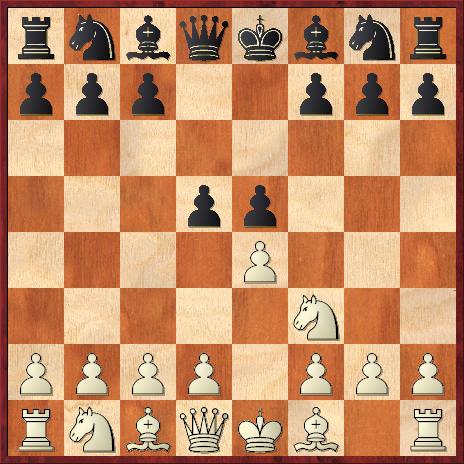
The Elephant Gambit:

So I had been kind of lazy about putting up a post and my friend Mike Zaloznyy a one time player of the Elephant Gambit suggested that I make it the next gambit in my series. Honestly, this gambit does not particularly impress me, but some of the ideas that occur within some variations are quite nice and I think it's an important opening to understand before I can later talk about the Marshall Gambit which also involved a d5 push that sacrifices a pawn. I hope you enjoy my analysis.
So I had been kind of lazy about putting up a post and my friend Mike Zaloznyy a one time player of the Elephant Gambit suggested that I make it the next gambit in my series. Honestly, this gambit does not particularly impress me, but some of the ideas that occur within some variations are quite nice and I think it's an important opening to understand before I can later talk about the Marshall Gambit which also involved a d5 push that sacrifices a pawn. I hope you enjoy my analysis.
Sunday, March 26, 2006
Gambits: Part 1 the Halloween Gambit
The Halloween Gambit:

I decided to start my series with a gambit that unlike traditional gambits which sacrifice pawns, starts out by sacrificing a whole piece. I think this gambit is particularly confrontational even at an early stage which makes it kind of exciting. Probably most players will see it and compare it to a gambit that doesn't have really any merit like the "Fred gambit" after 1. e4 f5 2. ef g6, but I think white has some obvious compensation that is likely just inadequate. This I didn't feel like going into too much detail, but I did give a sample line just to give a feel. You can check that out here.
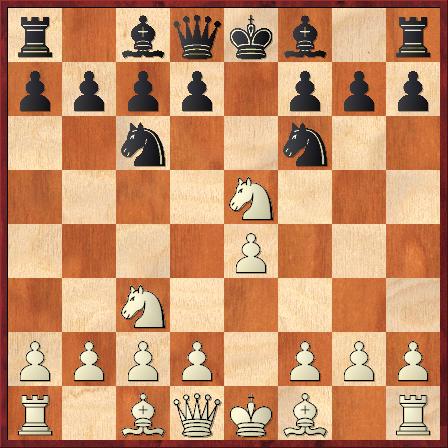
I decided to start my series with a gambit that unlike traditional gambits which sacrifice pawns, starts out by sacrificing a whole piece. I think this gambit is particularly confrontational even at an early stage which makes it kind of exciting. Probably most players will see it and compare it to a gambit that doesn't have really any merit like the "Fred gambit" after 1. e4 f5 2. ef g6, but I think white has some obvious compensation that is likely just inadequate. This I didn't feel like going into too much detail, but I did give a sample line just to give a feel. You can check that out here.
Thursday, March 23, 2006
Gambits: Part 0
I thought of an interesting idea for some posts and also for my chess development. My idea is to have a series going where I discuss a few more mainstream gambits that are quite common at the club level. I will also be throwing in some discussions of gambits that have seen some time in Super-GM games. I’ll also be discussing gambits that are mainlines such as the Chatard-Alekhine gambit against the classical French or the Marshall Gambits both against the semi-slav and on the black side of the Ruy Lopez. I don't know how many of these I'll get through before I'm tired of them, but if you have any suggestions on where I should start, I'm willing to listen.
So what's the point? Well, I think at high level chess quite often battles are fought just to get the initiative. While gambits for the most part artificially achieve this (by sacrificing one or more pawns), it's worth trying to figure out the differences between those gambits that are mainlines (i.e. Marshall Gambit) and those gambits that are rare in master games (i.e. Blackmar Diemer). I'm most curious in studying some key positions, not necessarily theoretical, where it seems that 1) the initiative is too small, 2) the initiative is in balance with the pawn or pawns, or 3) the initiative is enough to give an advantage despite being down material.
So what's the point? Well, I think at high level chess quite often battles are fought just to get the initiative. While gambits for the most part artificially achieve this (by sacrificing one or more pawns), it's worth trying to figure out the differences between those gambits that are mainlines (i.e. Marshall Gambit) and those gambits that are rare in master games (i.e. Blackmar Diemer). I'm most curious in studying some key positions, not necessarily theoretical, where it seems that 1) the initiative is too small, 2) the initiative is in balance with the pawn or pawns, or 3) the initiative is enough to give an advantage despite being down material.
Wednesday, March 22, 2006
Board Visualization and Blindfold chess
I've been absent from posting for a couple of days now. I'm on break from school for a week so I'm trying to take a little break from almost everything in my life. There are two major tournaments going on, one of which is a blindfold/rapid tournament taking place is Monaco. I think blindfold chess is one of those things that a layperson might think of as some kind of circus trick. However I think a person's ability to calculate accurately and a person's ability to play blindfold. I feel the more I have forced myself to analyze in my head the more I've seen an improved accuracy in my calculations.
Even just thinking back to 8 months ago, I would much more often in my calculation think a piece was still on a square it had already moved from hence miscalculating the whole variation. I'll admit, I still sometimes have this problem, but I've gained experience and hence catch myself when I'm doing it most of the time. I can play a blindfold game with some of my friends even at blitz time control but quite often the game ends to blunders I would never make with a board in front of me. I realize my ability to visualize will improve over time, but I think it's important to realize the connection.
The question of course then becomes how to improve visualization. Just playing games of chess does this. There are also exercises that can be done to help improve visualization. One I would like to highly recommend is outlined in an article on Chess Café by NM Dan Heisman and can be found among his archives here, but unfortunately I forgot which article it is. They are all very good articles so you won’t waste your time looking through them. I’ve also seen suggested chess mazes to quickly be able to visualize the patterns which pieces move. One I personally do is when I’m reading a chess book or magazine quite often it will spit out many moves in a row without a diagram. Rather than succumb to the urge to grab a chessboard, I try to walk through the moves slowly and I try to get a clear picture of the position in my mind as I move through and try not to make more moves on the board until I do. A good way to test your visualization of a position is to ask questions about why some “obvious looking” moves weren’t played. If anybody else has some good ideas I would love to hear about them in the comments.
Saturday, March 18, 2006
Octos Results
Well, I have a very successful tournament today. My first game I won a game against Danyul Lawrence (2037) where I got a little lucky his attack didn't work out. In the second game I was pair as white against Ilya Serpik (2311) who I actually had a 1-0 record against having black that game. This time I had white. I was clearly better out of the opening so he offered me a draw on move 10 and like a wuss, I accepted a draw since I was playing 200 points up and it was still far from a guaranteed win. Last round I was paired against a good friend Mike Zaloznyy who was in bad form this tournament and that bad form continued against me as he dropped a piece right out of the opening on the white side of a french exchange. To be fair, my position was already preferable, but it was still quite helpful.
After this tournament I'm expecting to gain between 16 and 19 points. I estimate I'll be 2128 after this tournament. 17 more points towards masterdom. Makes sense as I had a 2456!!!!! performance rating.
After this tournament I'm expecting to gain between 16 and 19 points. I estimate I'll be 2128 after this tournament. 17 more points towards masterdom. Makes sense as I had a 2456!!!!! performance rating.
Friday, March 17, 2006
Chess Tournament
I have my first tournament since the creation of this blog. I'm playing in the Costa Mesa Octos this weekend. Normally I try to avoid one-day tournaments as I'm trying to train myself to take more time and faster time control tournaments can screw this up a bit. Also this is a bit of drive for a one-day tournament, but the tournament scene in Southern California has been suffering a little bit so there aren't as many two-day tournaments. A friend of mine made a little bit of an effort to get a few stronger players to come out to this event. Looks like there are going to be like 4 or 5 solid experts and a couple of masters. I'll post an update to track my results.
Thursday, March 16, 2006
Pawn Endgame Solution
You might remember my earlier post about a pawn endgame I had in a recent tournament against a friend of mine. Well, I forgot about it for a few days and I still had to clean up my analysis, but finally it's up. I think it's a fairly principled position, but execution in these endgames can be tough. I missed my chance to win, hopefully you didn't miss it. Check out the solution here.
Tuesday, March 14, 2006
Chess, Poker, and Procrastination
So it seems quite a few chess players are busy these days playing poker. My friend NM Eugene Yanayt is on a poker cruise right now having qualified for it on party poker. I talked to him online today and he mentioned there were a couple of GMs in the tournament. Apparently Walter Browne and Jan Gustafsson a 2600 from Germany are on the cruise. I asked him to challenge them to a side game of blitz, but he said the only set on the ship was a big one by the hot tub where the pawns were just small bishops. I personally used to play a bit of poker myself. I gave it up because I was falling behind in school and didn't want to give up chess, but quite a few people seem to make the other choice.
Both of these activities can suck up a good deal of your time if you're not careful. I'm generally of the opinion that any time spent on chess cannot be a waste, but sometimes things get put off until the last minute that would be better done at an earlier time. However, some people ask me where in my busy schedule I find time to study as much chess as I do and the simple answer is procrastination. When I'm not doing my homework, essay, or exam, I can be studying chess. I think it's quite effective, a lot better use of time than my former marathons of staring at the wall.
Both of these activities can suck up a good deal of your time if you're not careful. I'm generally of the opinion that any time spent on chess cannot be a waste, but sometimes things get put off until the last minute that would be better done at an earlier time. However, some people ask me where in my busy schedule I find time to study as much chess as I do and the simple answer is procrastination. When I'm not doing my homework, essay, or exam, I can be studying chess. I think it's quite effective, a lot better use of time than my former marathons of staring at the wall.
Tactics vs. calculation
I think this is an interesting issue I don't appreciate often enough. Quite often I do endgame studies and tactical exercises. I find the latter quite easy and the former a bit more difficult. Tactical exercises have their own set of themes and endgame studies have their own set of themes, but tactics train real game situations whereas endgame studies are mostly just about calculation. I noticed in some of my games how easy it is when I have a strong positional bind to get confused while looking for tactics. For example, in the recent Amateur Team West tournament I arrived at the following position against a weak expert as black with my move:
 So my opponent just play Nb1-a3 which really should have signaled something. I was kind of annoyed by this move but not too worried as his hole on c4 was already giving me a nice positional edge. However, had I spotted 1...Bxe2! I would have had both a material edge and a positional advantage. This really shouldn't be that hard for me to spot and I can't come up with any reasonable excuse for not seeing it. The bottom line is I need to be more aware of knockouts like this since I quite often develop a positional advantage but if I don't see shots like this I might throw away half points sometimes. Fortunately in this game I went on to get the full point, not without allowing a little bit of complication on the board though.
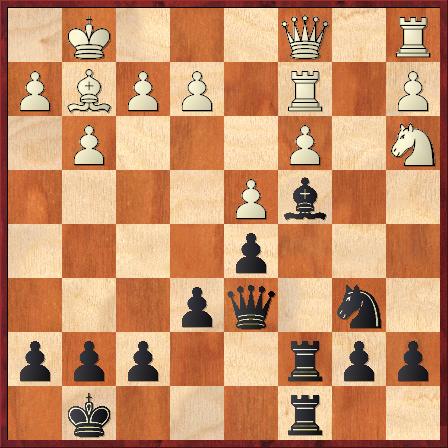 So my opponent just play Nb1-a3 which really should have signaled something. I was kind of annoyed by this move but not too worried as his hole on c4 was already giving me a nice positional edge. However, had I spotted 1...Bxe2! I would have had both a material edge and a positional advantage. This really shouldn't be that hard for me to spot and I can't come up with any reasonable excuse for not seeing it. The bottom line is I need to be more aware of knockouts like this since I quite often develop a positional advantage but if I don't see shots like this I might throw away half points sometimes. Fortunately in this game I went on to get the full point, not without allowing a little bit of complication on the board though.
Sunday, March 12, 2006
New US Champions
ONISCHUK IS THE NEW US CHAMPION.
Onischuk won the rapid games for the title and the extra $8,000. Both games were complicated: the first one ended in a drawn opposite color bishop endgame that fortunately Onischuk did not try to win on the delay. The second game was even more complicated than the first with a massive struggle on the board. Both sides missed key opportunities, it could have been much more interested to see this game at classical time controls as there were many missed moves, but both sides showed their strength in defending brilliantly even with little time on the clock. I have made some notes to the second decisive game here. Congratulations to the new US champion and I would like to congratulate Shulman and the rest of the field for their fighting spirit this year.
ZATONSKIH IS THE NEW WOMENS US CHAMPION.
Zatonskih outplayed Goletiani in the rapid matches to become the new US Champion. I slept in a bit so I did not get a chance to see these games live, but both were exciting. After winning the first game as black Zatonskih put herself in a very good position to become the new champion. The second game was pretty sharp as well, but Zatonskih found a way to force a draw which would seal the championship and took it. Congratulations to the new champion.
Subscribe to:
Posts (Atom)