Friday, March 31, 2006
Amateur Team Playoffs


A Lesson in Defense

You probably need to stare at this position to figure out what's going on. Currently black has a serious threat of Bd6 winning on the spot. There are a few moves that come to mind to try to defend against it. Obviously white must move his f-rook, but only one square works, can you figure it out? Don't just stop at the first move, think of critical variations, even after the correct response (or incorrect responses) white still must find some tricky moves. I'll leave this to ponder for a couple of days. Your choice between Rfb1, Rfc1, Rfd1, and Rfe1.
Tuesday, March 28, 2006
Gambits: Part 2 -The Elephant Gambit
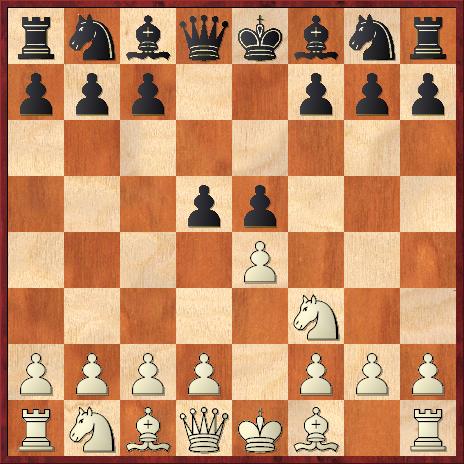
So I had been kind of lazy about putting up a post and my friend Mike Zaloznyy a one time player of the Elephant Gambit suggested that I make it the next gambit in my series. Honestly, this gambit does not particularly impress me, but some of the ideas that occur within some variations are quite nice and I think it's an important opening to understand before I can later talk about the Marshall Gambit which also involved a d5 push that sacrifices a pawn. I hope you enjoy my analysis.
Sunday, March 26, 2006
Gambits: Part 1 the Halloween Gambit
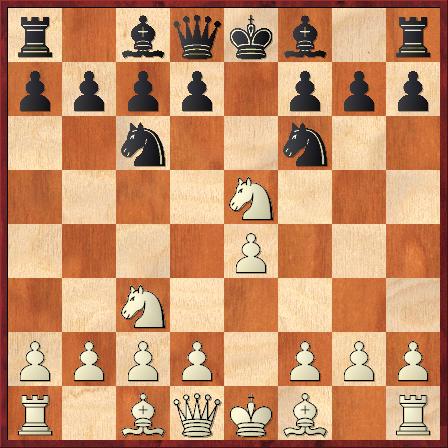
I decided to start my series with a gambit that unlike traditional gambits which sacrifice pawns, starts out by sacrificing a whole piece. I think this gambit is particularly confrontational even at an early stage which makes it kind of exciting. Probably most players will see it and compare it to a gambit that doesn't have really any merit like the "Fred gambit" after 1. e4 f5 2. ef g6, but I think white has some obvious compensation that is likely just inadequate. This I didn't feel like going into too much detail, but I did give a sample line just to give a feel. You can check that out here.
Thursday, March 23, 2006
Gambits: Part 0
So what's the point? Well, I think at high level chess quite often battles are fought just to get the initiative. While gambits for the most part artificially achieve this (by sacrificing one or more pawns), it's worth trying to figure out the differences between those gambits that are mainlines (i.e. Marshall Gambit) and those gambits that are rare in master games (i.e. Blackmar Diemer). I'm most curious in studying some key positions, not necessarily theoretical, where it seems that 1) the initiative is too small, 2) the initiative is in balance with the pawn or pawns, or 3) the initiative is enough to give an advantage despite being down material.
Wednesday, March 22, 2006
Board Visualization and Blindfold chess
Even just thinking back to 8 months ago, I would much more often in my calculation think a piece was still on a square it had already moved from hence miscalculating the whole variation. I'll admit, I still sometimes have this problem, but I've gained experience and hence catch myself when I'm doing it most of the time. I can play a blindfold game with some of my friends even at blitz time control but quite often the game ends to blunders I would never make with a board in front of me. I realize my ability to visualize will improve over time, but I think it's important to realize the connection.
The question of course then becomes how to improve visualization. Just playing games of chess does this. There are also exercises that can be done to help improve visualization. One I would like to highly recommend is outlined in an article on Chess Café by NM Dan Heisman and can be found among his archives here, but unfortunately I forgot which article it is. They are all very good articles so you won’t waste your time looking through them. I’ve also seen suggested chess mazes to quickly be able to visualize the patterns which pieces move. One I personally do is when I’m reading a chess book or magazine quite often it will spit out many moves in a row without a diagram. Rather than succumb to the urge to grab a chessboard, I try to walk through the moves slowly and I try to get a clear picture of the position in my mind as I move through and try not to make more moves on the board until I do. A good way to test your visualization of a position is to ask questions about why some “obvious looking” moves weren’t played. If anybody else has some good ideas I would love to hear about them in the comments.
Saturday, March 18, 2006
Octos Results
After this tournament I'm expecting to gain between 16 and 19 points. I estimate I'll be 2128 after this tournament. 17 more points towards masterdom. Makes sense as I had a 2456!!!!! performance rating.
Friday, March 17, 2006
Chess Tournament
Thursday, March 16, 2006
Pawn Endgame Solution
Tuesday, March 14, 2006
Chess, Poker, and Procrastination
Both of these activities can suck up a good deal of your time if you're not careful. I'm generally of the opinion that any time spent on chess cannot be a waste, but sometimes things get put off until the last minute that would be better done at an earlier time. However, some people ask me where in my busy schedule I find time to study as much chess as I do and the simple answer is procrastination. When I'm not doing my homework, essay, or exam, I can be studying chess. I think it's quite effective, a lot better use of time than my former marathons of staring at the wall.
Tactics vs. calculation
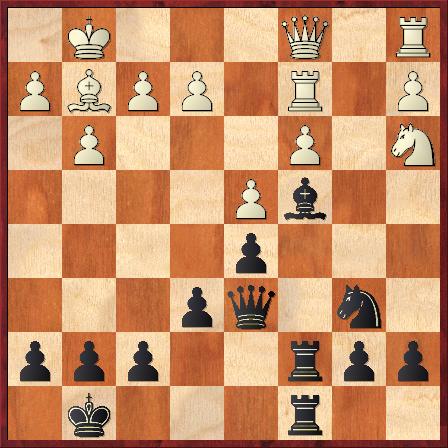 So my opponent just play Nb1-a3 which really should have signaled something. I was kind of annoyed by this move but not too worried as his hole on c4 was already giving me a nice positional edge. However, had I spotted 1...Bxe2! I would have had both a material edge and a positional advantage. This really shouldn't be that hard for me to spot and I can't come up with any reasonable excuse for not seeing it. The bottom line is I need to be more aware of knockouts like this since I quite often develop a positional advantage but if I don't see shots like this I might throw away half points sometimes. Fortunately in this game I went on to get the full point, not without allowing a little bit of complication on the board though.
Sunday, March 12, 2006
New US Champions
Onischuk won the rapid games for the title and the extra $8,000. Both games were complicated: the first one ended in a drawn opposite color bishop endgame that fortunately Onischuk did not try to win on the delay. The second game was even more complicated than the first with a massive struggle on the board. Both sides missed key opportunities, it could have been much more interested to see this game at classical time controls as there were many missed moves, but both sides showed their strength in defending brilliantly even with little time on the clock. I have made some notes to the second decisive game here. Congratulations to the new US champion and I would like to congratulate Shulman and the rest of the field for their fighting spirit this year.
ZATONSKIH IS THE NEW WOMENS US CHAMPION.
Zatonskih outplayed Goletiani in the rapid matches to become the new US Champion. I slept in a bit so I did not get a chance to see these games live, but both were exciting. After winning the first game as black Zatonskih put herself in a very good position to become the new champion. The second game was pretty sharp as well, but Zatonskih found a way to force a draw which would seal the championship and took it. Congratulations to the new champion.
Saturday, March 11, 2006
US Championship Round 9: Results
Round 9 brought a lot of excitement. There were quite a few players chasing norms and tough fights on the top boards. Nakamura looked like he was just worse against Onischuk then exploded with b5 with a dangerous looking attack. Onischuk showed his defensive genius and held on. Nakamura took his typical risks to push in but in the end the game was just a draw. Shulman looked like he was slightly worse out of the opening but seemed to have moves that looked like they would equalize. He didn't play them and soon found himself the victim of a huge initiative. Even after all this drama it will still be a Onischuk vs Shulman in the rapid playoffs. In the women’s group it ended up being Zatonskih vs Goletiani. All of these should be exciting.
There were quite a few norms achieved this year. Friedel made his 2nd GM norm, Tuvshintugs made a WGM norm despite losing her last four games in a row which just shows how impressive her first five rounds were, and Goletiani made an IM norm. Congratulations to all of these players for their impressive results. Between this result and the result from Friedel's last GM norm he should be pushing the 2500 mark soon.
So my predictions were pretty terrible today with a spectacular 1/6. Oh well, I guarantee you I won't be able to miss this many tomorrow. So the playoffs I think actually will favor Shulman. His rapid ability was shown to be pretty good in the World Cup so my money is on him to take it. This is definitely the underdog, but I like to root for the underdog. As for the women's playoff I think Zatonskih will take this. Goletiani is the defending champion but Zatonskih I think is a significantly stronger player and really just got unlucky last year by having tougher last round pairings allowing Goletiani and Abrahamyan to pass her while she played a tough GM in the last round.
Chess Club and US Champs all rolled into one
So the reason why I'm posting so late is because I had a bit to drink, went to chess club, had some more to drink, hung out with some friends for a while and just got home. I think when people think of "going to Caltech to play chess" they think of far more scholarly events than this pretends to be. Anyways, US Chess Championship updates.
The top boards in both sections drew. Nakamura won a strange game against Gurevich. Ibragimov beat Friedel very technically and Christiansen beat Perelshteyn. What does this mean as a whole? This means that going into the final rounds it is very likely that Onischuk and Shulman will be their respective group winners, I have no idea who is a better rapid chess player and am quite disappointed that I should care.
I'm too tired to round up the results completely, just look at them at the site, I've linked there, sorry, big one time slip.
Predictions:
So yesterday I had my very typical 3/6 although I should've been able to do much better. Oh well, solid mediocrity is worth something I think. Anyways, here's my predictions for tomorrow, my guess is that about 1/2 of them will be correct.
Group A:
GM Onischuk - GM Nakamura 1-0
I know this may sound like an absurd prediction being that Onischuk only needs a draw, but I could see Nakamura pushing WAAAAAAY to hard in a game like this. I know Nakamura is a great fighter, but sometimes discretion is the greater part of valor.
GM Akobian - GM Ibragimov 1/2
This is actually quite an important game, Ibragimov could potentially beat Onischuk on tiebreaks if he loses, but I think that this will be a very tough game for either side to win. Both players are doing well and I believe this will just peter out.
GM Stripunsky - GM Goldin 1-0
Stripunsky is pretty clutch if you can remember his last round victory in last year's US Championship. I may have doubted him at the beginning, but I really think this guy is incredibly tough to face in a practical game. He may play offbeat stuff, but it's all sound, just the not the most critical lines.
Group B:
GM Fishbein - GM Shulman 1/2-1/2
Since Shulman has played everyone remotely close in score to him he is now playing a point and a half down against a player who doesn't need to win as badly as he needs to not lose. I don't see any reason Shulman won't be able to draw this, he's clearly in great form.
GM Kamsky - GM Shabalov 1/2-1/2
I think this will be a very tense battle, but I think as both of these players sense that Board 1 is not going to be decisive they'll just take the GMs favorite results and enjoy a few drinks at the bar.
GM Yermolinsky - GM Christiansen 1/2-1/2
Okay, maybe it's absurd to predict 4 draws in the 6 most important games of the tournament, but I did so live with it. I think these two experienced players will both be playing fine chess, there might even be a good fight, but chess is probably a draw so this game might be too. Yea, I know these are lazy explanations, but I'm REALLY tired.
Good luck to all norm possible players in the last round, I don't know who is in contention, but that might show up tomorrow on the website hopefully. Goodnight.
Friday, March 10, 2006
Traditions
My house (not a fraternity, but similar) has a tradition of going to the center of campus and drinking champagne at the end of every term which I just came back from. Tradition is something I'd like to talk about. The tradition of the US Championship used to be two round robins of which the winners would play a match. The format more recently changed to a 64 player format and a giant swiss. For financial reasons this was probably a good decision, but this year's event has problems that I believe completely outweigh any financial benefits that could've come from forcing a rapid playoff. Let us look at one example: Let's say Zatonskih won her group and a man won the other group. Zatonskih would then play the playoff for the overall championship, but due to the format if she lost that match she would not even be the women’s champion when potentially the girl that scored fewer points than her in the same group could hold the title. The fact that this is possible shows that there is a flaw in the current system beyond the fact that the title will be determined in rapid chess.
I realize having a rapid chess playoff is exciting for the fans, but this is a ridiculous system. This is equivalent to having the basketball playoffs played out normally until the finals, but then instead of the finals having a slam dunk contest to decide the championship. I realize that a lot of people would find this very entertaining but I think as a whole this would be bad for the sport and I think as a whole this format is bad for chess in the
Thursday, March 09, 2006
US Championship Round 7: Results / Round 8: Preview
In board 2 of group A Southern California player Varuzhan Akobian managed to win a lost rook and pawn endgame, now that's technique! Friedel beat Dlugy in a nice game to make amends for his loss yesterday which now puts him back into that group tied for 3rd. Nakamura is trying to continue his comeback with a win this round over GM De Firmian in typical Nakamura fashion. He got a bad position from the opening but continued to move quickly and put a lot of pressure on De Firmian who fell apart in time trouble.
Probably craziest game of the round was Kamsky's win over Novikov. It was a Bg5 Najdorf that got into an endgame where Kamsky was trying to make good with his Q+N vs Q+B. On move 41 Novikov sacrficed his bishop for a dangerous passed pawn and then won another pawn which was captured on move 44 in the process leaving him with a queen plus three pawns versus Kamsky's queen, knight, and 1 pawn. Kamsky couldn't trade queens under any condition to win and really pressed hard trying to win something delightful to see from Kamsky this tournament. So Kamsky was finally successful in breaking through, but he was going to have a problem due to the 50 move rule, but on move 92 Kamsky finally broke through with a move that would allow a queen trade on the following move into a winning queen endgame. It came down to one of the last possible moves for him to win.
Standings:
Group A: Onsichuk(6), Akobian (5), 7 others (4.5)
womens: Goletiani(3.5), Baginskaite, Ross, Zenyuk (3)
Group B: Shulman (6), Kamsky (5), Novikov, Christiansen, Perelshteyn, Fishbein, Yermolinsky (4.5)
Exciting results this round, I managed to predict 3/6 results correct this round, but the ones I got wrong all ended under very strange circumstances just to tease me. Anyways my predictions for this round are:
Group A:
GM Akobian - GM Onischuk 1/2-1/2
I think stylistically Akobian will have a tough time against Onischuk just because Onischuk is the stronger player and their play is pretty similar. I really think this game has the possibility for all 3 results due to how important a win is for Akobian.
GM Nakamura - GM Gurevich 1-0
Nakamura played very well in his last game and I'm sure has gotten a lot of his confidence back so I expect him to be in proper form to beat Gurevich. I have warned myself not to doubt Gurevich in earlier rounds, but I think this result is my best prediction. However, I think the chance of Nakamura winning Group A are essentially nil. Since Onischuk has been leading the whole time even .5/2 in the last 2 rounds will probably seal him first on tiebreaks assuming he doesn't lose to Akobian. Of course if Onischuk does lose to Akobian then for Nakamura to win on tiebreaks would probably require none of the other 4.5s to finish with 6.5 which is possible, but would probably require a lot of luck as there is at least one more possible. But Nakamura is NOT mathematically eliminated just damn close.
GM Ibragimov - IM Friedel 0-1
This prediction is not based on my feeling that Friedel is better than Ibragimov more that it seemed in the last round that Ibragimov is getting tired over the course of a long event. This was probably the reason for his failure to convert in the last round of last year's US Championship and this year there were far fewer rest days. Josh has been fighting hard, it wouldn't be completely inconceivable to see a draw here, but I think he'll have a good shot for the full point.
Group B:
GM Shulman - GM Kamsky 1/2-1/2
I DO expect Kamsky to be pushing for the full point, but I think if Shulman were going to collapse it would've been last round. Kamsky has only one win with black so far and I expect this trend to continue. Shulman has especially strong interest in drawing here as it will likely lock up the group on tiebreaks.
GM Fishbein - GM Novikov 0-1
I can't imagine Novikov is happy with his loss last round and otherwise seems to be in good form. I think he'll come out in round 8 with a taste for blood. Let's also not forget that while Fishbein has the same score he doesn't have a single win against a player with a plus score and only one draw in that group.
GM Christiansen - IM Perelshteyn 1/2-1/2
I heard that for the first time in a few years Christiansen actually analyzed before this event which explains his results so far, but Perelshteyn's only loss is to Ivanov so his preparation is also looking pretty good. I expect Christiansen to fight hard, but in the end a draw is what I expect.
Wednesday, March 08, 2006
Round 6 Results / Round 7 Predictions
In group B there weren't too many surprises at the top other than Novikov beating Shabalov very nicely to land in clear second place having already played Shulman. Going down to lower boards Abrahamyan beat Muhammad to join Zatonskih for second place for the women in group B. Tuvshintugs lost to Kamsky but due to her previous huge lead still is in clear first in the womens race.
Standings:
Group A:
1st: Onischuk (5)
2nd: Gurevich, Schneider (4.5)
4th-7th: Ibragimov, Akobian, Stripunsky, de Firmian (4)
Womens: Goletiani (3), Vicary (2.5)
Group B:
1st: Shulman (5)
2nd: Novikov (4.5)
3rd-4th: Kamsky, Christiansen
Womens: Tuvshintugs(3.5), Zatoniskih, Abrahamyan (3)
So there are some close races with just three rounds remaining.
So my predictions fell to 2/6 today, but that's about what's expected. My overall record is 16/36. For tomorrow:
Group A:
GM Onischuk - IM Schneider 1-0
I think Onischuk will be pressing pretty hard to win this game against a less-experienced opponent knowing that there are quite a few people in hot pursuit of him. Onischuk does have white so he will probably aiming for a position where he can play for a win with little risk. The last two times these two players met it was a draw which I think just gives Onischuk that much more reason to try to prove something with a win.
GM Gurevich - GM Akobian 1/2-1/2
Both of these players have been doing well, but I expect a solid game where neither will have particularly great chances to win.
GM Stripunsky - GM Ibragimov 0-1
This will probably be some kind of KIA French where I expect Ibragimov will get a good chance to show his class. Ibragimov's preparation actually looks pretty good and his only loss was just a blunder which I don't think has reflected his overall form.
Group B:
GM Shulman - GM Kaidanov 1-0
Shulman is playing down 1.5 points in terms of tournament score which indicates to me that especially with white he will be in very good shape to try to win and maintain his lead. This is especially important due to the format of the tournament where he may wish to be able to take a draw in the later rounds to conserve his energy for a potential playoff.
GM Kamsky - GM Novikov 1/2-1/2
Kamsky has been playing peacefully since the first round except in the game where he has been playing 400 points down so I don't see why that trend should stop here. It's not impossible that he start to try to find more winning chances, but even a draw here will almost guarantee a game against Shulman next round which is really the game he needs to win to have a shot.
GM Gulko - GM Christiansen 1/2-1/2
If there were days off every three days this is where it would land so I expect some players to take a day off anyways. I expect a draw right around 30 moves as Christiansen has looked very solid so far anyways.
Tuesday, March 07, 2006
US Champ Round 5: Recap / Round 6 predictions
This round had some fun upsets worth mentioning. Tuvshintugs scalped Becerra as black for her 3rd GM scalp of the tournament. Notice her only loss of the tournament is to Shulman who is in clear first, seems to be a breakout tournament for her. If she nets a few more point she'll be in good shape for a WGM norm or better. Friedel continued his undefeated streak by drawing from a better position against Stripunsky, I might take a look at that game later. Bercy's lost to Kudrin in a tough game, he was completely winning at some point, but then lost the game in time trouble, I might also take a look at that game. Nakamura won again showing he will be able to put pressure on the leaders if they keep drawing (although even if he ties his tiebreaks will be terrible).
This round did not see too much change among the leaders. The key difference was that with Shulman's win as black he also gained another half point on the field in group B. So here are the standings in the two groups:
Group A:
1st: Onischuk, Gurevich (4.0/5)
3rd: Schneider, De Firmian, Friedel, Kudrin (3.5/5)
Womens: Goletiani (3) with her trailiers having only 2 points
Group B:
1st: Shulman (4.5/5)
2nd: Novikov, Christiansen, Shabalov, Tuvshintugs(w) (3.5)
Womens: Tuvshintugs (obviously) with Zatonskih at 3 and other women at 2 or less.
Now let’s move onto my predictions. I realize this is all a little bit silly, but it does force me to look at a couple of games by these players which can't be bad. Yesterday I scored 3/6 again which I consider to be reasonable success (as once again, there are THREE results). This brings my overall record to 14/30; I hope to improve upon this today.
Group A:
GM Kudrin - GM Onischuk 1/2-1/2
So Kudrin can go into the Ruy Lopez and he can also play the Gioco Piano, my bet is on the latter but I imagine it will be a close call. I expect his preparation to be good since he's been playing this line for a while, but at the same time this line tends to be a little drawish and I don't expect Onischuk to push too hard as black, but again I could be wrong.
GM Gurevich - GM De Firmian 1-0
Gurervich is playing quite well, I am no longer going to doubt his play. De Firmian is also playing well, but seems to be having a little more trouble than Gurevich. He was likely dead lost last round against Schneider as black in a very popular line which suggests his preparation is not as good as it should be.
IM Schneider - IM Friedel 0-1
It's a little weird that these two both have the same color they had in round 5, but it's probably because one or both of them was forced not to alternate in a previous round. I'm not sure what type of Ruy Lopez Josh will pick. These two have an even record (1-1) against eachother, but Josh had black both times and they were 2 different lines of the Ruy Lopez and the one Josh won was the archangel so I wouldn't be surprised to see him go back to that. Either way while both of these young players have had good results Josh seems to be in significantly better form so I give the edge to him.
Group B:
GM Christiansen - GM Shulman 1/2-1/2
This is an interesting situation. Christiansen has white so it would seem ready for him to win again, but Shulman seems playing well. Christiansen has also been playing the Tarrasch against the French lately which is exactly the line Shulman played against last round. I think Christiansen plays these fairly modern lines with Ngf3 so I don't know what to expect and when in doubt I'll pick draw. I'm sorry for the copout, but I don't know what else to do. This is also an important game for Shulman as Christiansen is the only player tied for 2nd he hasn't played, if he can keep a half or full point lead with no direct matchups left against his followers he'll be in a really good position.
GM Novikov - GM Shabalov 0-1
Shabalov is actually having a pretty good tournament. His game against Shulman was pretty wild and unclear which was the only game he lost. I predict he will keep up his good play and win.
WFM Tuvshintugs - GM Kamsky 0-1
Kamsky may have draws in his last 4 games, but he is playing 450 points down. I realize Tuvshintugs is obviously playing well and I would like to see her continue, I still think Kamsky will win this, even as black.
Pawn Endgames
1) They are good positions to study to help to work on calculation (as I've heard from my coach and various other sources).
2) You might need to calculate them while making decisions as to whether or not the pawn endgame is good or at least okay in other endgames such as rook endgames (which occur in occur in 8.5% of all games) or rook + minor piece endgames (which occur in 15% of games).
Studying endgames is something I don't think I've done properly up until now. I think my judgment of such endgames is normally pretty good, but I find I have to work very hard while playing minor piece and pawn endgames. This is important as my play in complicated endgames and "queenless middlegames" is pretty good and I often rely on these as escapes when I start to get into trouble. So to start with I'm going to be working through Secrets of Pawn Endgames also by Müller and Lamprecht to both improve my pawn endgames and also work on my calculation. So as an introduction I decided to include a complicated position from one of my more recent tournaments where in the last round I was playing a friend and we reached the following position. White having just played b2-b3:
From Rocklin - Gutman
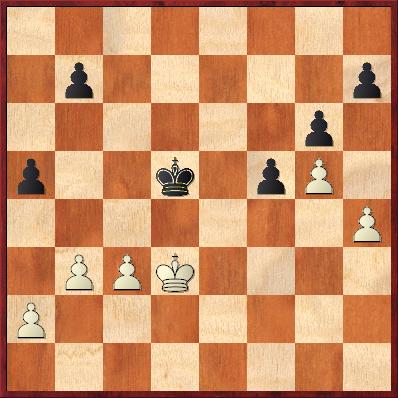
Black to move:
I'll leave this up for a day or two. Clearly black is better, but can he win this and if so, how?

You get what you pay for???
 You can click on the image to see the full-size.
The question is if someone clicks on the ad does Silman chess still have to pay for it and do they still get paid for the click-through?